backpocket.website
Four years in problem solving · three as a Product Manager

Gaurav Singh Complex systems, simple products

Product manager on delivery platforms and marketplaces. I own Flash at uEngage.

Every case study names a decision I got wrong. That is the part worth reading.

Three years as a product manager, owning platform products end to end. Discovery, roadmap, prioritisation, and the calls in between. Mostly operations-heavy software, across several markets. The kind of product where a bad decision shows up in somebody’s evening rather than in a dashboard.

I build things of my own as well. The four tools below are live and free, and the people using them are not me. I write them at night and on weekends. It keeps me honest about what I am asking engineers for when I put something on a roadmap.

What I’ve owned

The scope, the systems and the decisions. Volumes, revenue and service levels belong to the companies that paid for them, so those are not here. What is here is the movement: where something started, where it got to, and the calls I made to move it. Codeshod’s own figures are in full, because that company was mine.

Product Manager

uEngage · Dec 2024 – present

I own Flash, uEngage’s delivery platform. That covers own-fleet management, 3PL integrations, the rider app, the support tooling, and the interfaces merchants and customers actually touch.

Four audiences with conflicting incentives sit on one system: the person waiting for dinner, the merchant making it, the rider carrying it, and the ops team who hears about it first when any of the three breaks. There is no staging environment for a hungry customer. A mis-assigned rider is somebody’s birthday cake at the wrong address. A regression at 8pm is a dinner that never turns up.

So most of the job is deciding which failures the system should absorb quietly and which it has to surface loudly. That thinking drove automated escalation handling, proactive updates to the customer, and live tracking while an order is in flight. The own-fleet strategy came out of the same question. I defined the North Star metric, the staffing model and the phased rollout for it.

What changed while I owned it. Rider assignment used to sit in the low seventies and slipped under that on bad days. It holds in the mid-nineties now. I introduced on-time delivery rate as the number the team watches, because nothing we already tracked told us whether the promise we made the customer actually held; it has gone from under half of orders to a little over three quarters. Third-party logistics integrations went from four to sixteen. Daily escalations came down by roughly 60% while throughput more than tripled, and that is the one I care about most, because the easy way to cut escalations is to have fewer orders.
  • Own-fleet management
  • 3PL integrations
  • Rider app
  • Merchant tools
  • Customer experience
  • Support systems
  • POS & API integrations
  • Unit economics

Read the Flash case study →

Product Associate, then Junior Product Manager

Ikarus 3D · Aug 2023 – Dec 2024

After Codeshod I wanted to learn the craft inside a company that already had a product organisation, rather than keep teaching myself on my own runway. I joined as a Product Associate and converted to Junior Product Manager on a pre-placement offer.

Product execution for a 3D commerce platform, integrated across nine e-commerce surfaces including Shopify and Amazon. Planned and delivered an enterprise deployment for Bharat Electronics Limited from the ground up, used for showing product to international delegations.

The work was immersive commerce: 3D product experiences, with AR, VR and MR alongside them. I managed a product catalogue and learned digital asset management properly, which is the least glamorous thing I picked up there and the one I still use every week. Clients were spread across the world, and that was my first real exposure to how differently the same product gets read from one market to the next. This is where the business side of the job started to make sense to me. Economics stopped being something the finance team owned.

  • 3D commerce
  • Immersive experiences
  • AR, VR & MR
  • Marketplace integrations
  • Catalogue management
  • Digital asset management
  • Global clients
  • Enterprise delivery

Read the Ikarus case study →

Founder & Product Manager

Codeshod Ventures · Jan 2022 – Jul 2023

Built and launched a skill-based matchmaking platform from nothing to 3,500+ users, onboarded 37 clients, and grew retention 40% through cohort-based execution. It won a MeitY innovation grant. I ran all of it alongside my Computer Science degree.

The community was the part that worked. We ran cohorts and events across several universities, and sent our own teams to flagship industry events where students got exposure a classroom does not give them. What did not work was the model underneath it. I was trying to build something that would keep running without constant manpower, and I did not get there, so every bit of growth cost us more people and more cash. We shut operations down. I came out of it thinking about unit economics first, which is not how I went in.

  • 0–1
  • Marketplace
  • MeitY grant
  • Founder

Read what went wrong at Codeshod →

What I work in

  • Hyperlocal delivery
  • Last-mile logistics
  • Fleet management
  • 3PL orchestration
  • POS & API integrations
  • Unit economics
  • Marketplaces
  • B2B SaaS

B.E. Computer Science, Chitkara University. The long version is on LinkedIn.

Teardowns

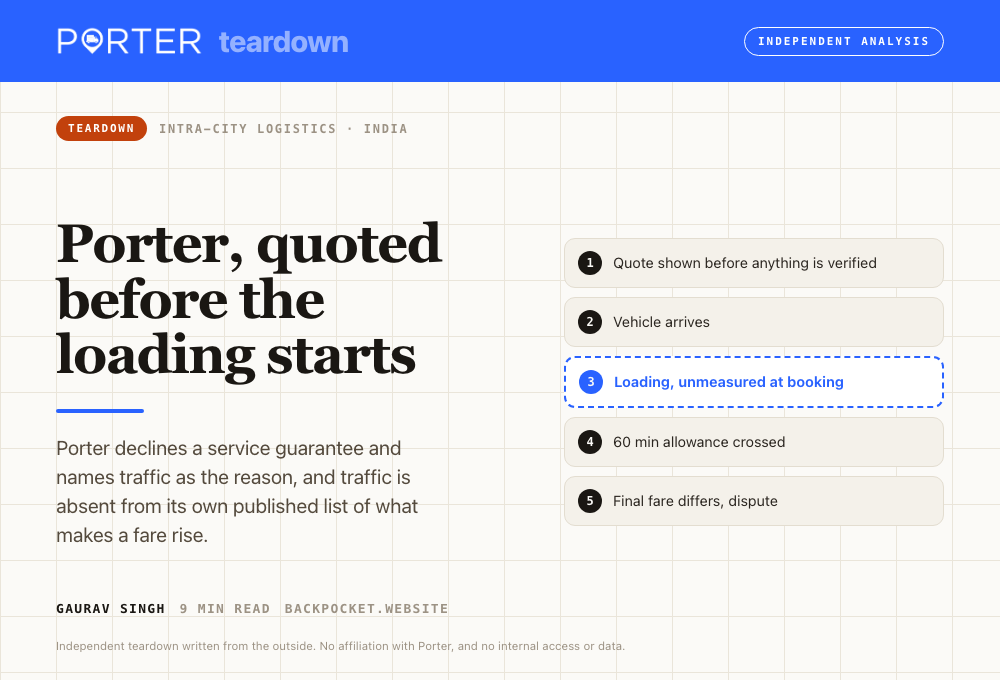
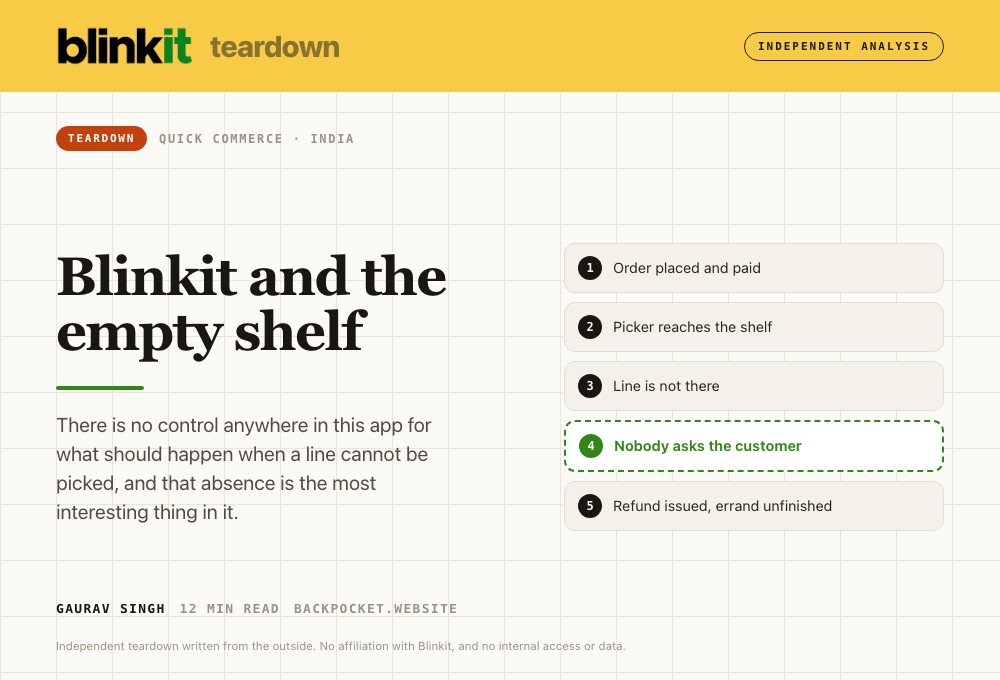
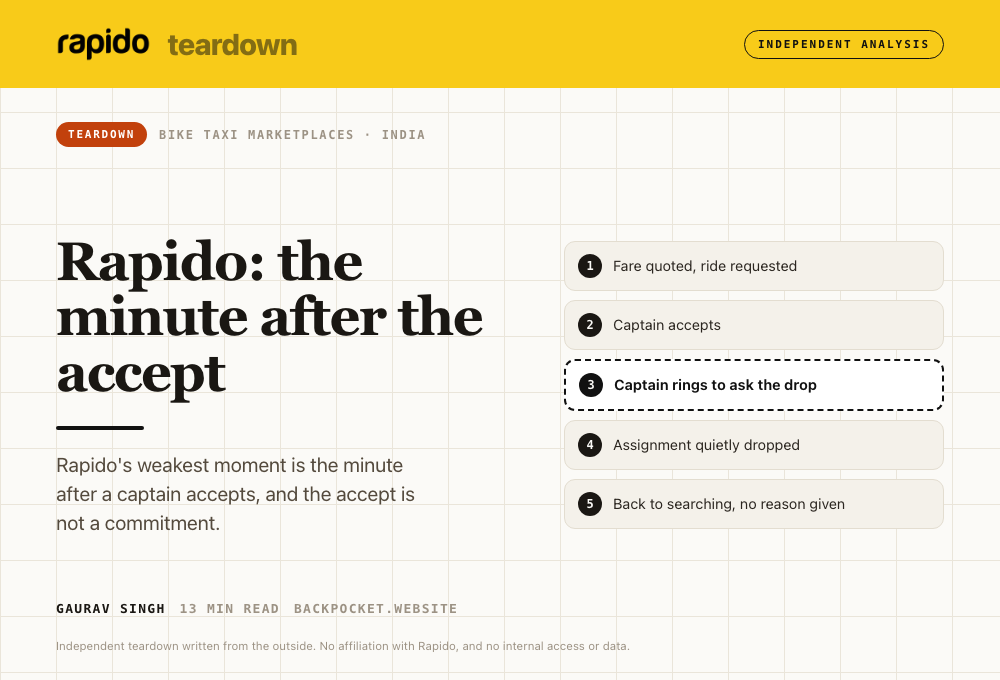
Three products I have never worked on, taken apart from the outside. No internal access and no privileged information, which is the point: this is how I frame a problem, choose a metric and accept a trade-off with none of my own context to lean on. Each one says what it is based on, and what would change my mind.

Personal projects

Not work samples — actual software, running, free, used by people who are not me. Each one started as a job I had and could not find a decent tool for. They are also the cheapest way I know to stay honest about what an engineering estimate means.

Live
01

GuideGen

Record a workflow in your browser once. Get numbered steps with annotated screenshots — and one click copies the whole thing as text an AI can act on. Exports as a web page, Markdown, PDF, slides or a narrated video.

Live
02

Cut

Drop a recording once: it takes out every silence and three-second fumble, burns in captions that land on the word, and cuts the vertical clips worth posting. Backpocket AI does the listening in your tab — a 400MB file never leaves your machine.

Live
03

Wrapped

Your year, from a file you already have. Export a WhatsApp chat and find out who texts first, who replies faster and who double-texts at 1am; export your calendar and find out what the meetings actually cost. A card or a video, made in your own tab.

Live
04

Spot

Paste your website. Get a twenty-second ad with your colours, your logo, your own words and a voiceover — the brand read off the card image you already publish, the video encoded in your tab. The most expensive thing here to run, at almost nothing.

Backpocket AI

My name for the intelligence in these tools — the thing that listens to a recording, reads a chat, writes a quiz. It is one name across more than one machine, and where it runs depends on the tool. Every page says which, and so does this one, because a single word covering two very different mechanics is how somebody ends up assuming their footage was uploaded.

It is also an argument, and the reason it is worth naming: not everything clever has to be over-engineered. These tools do work competitors pay a GPU bill for, in a browser tab, for nothing — a decision taken early and defended against every later feature that wanted a server. I would rather find the approach nobody else is taking than spend money proving the obvious one works.

ProductWhere the work happensWhat it costs me
GuideGen Your machine ₹0 per guide
Cut Your machine — a 41MB model, downloaded once ₹0 per clip
Wrapped Your machine, then one model call if you ask for it ₹0 counted · a fraction of a rupee to read
Spot Your machine, bar one HTML fetch ≈₹0.30 per ad

Four products live, on a free hosting tier, with no fixed monthly cost at all. The rendering, the speech and the video all happen in the visitor’s own tab. That is why free is sustainable here rather than a trial that has to end. The tools I compared this against bill per GPU-minute and per speech call, which is usually what the usage caps are protecting.

In Cut, it runs on your machine

The model is downloaded once — 41MB — and does the listening inside your own tab. Nothing is sent, and there is nothing to send it to. This is the version of "AI" that costs you no privacy at all, and it is why Cut can be free with no limits.

In Wrapped, it leaves the page

Reading a chat is more than a laptop can do well, so that request goes out to a model service. It is optional, the page says so before you press, long digit runs and link tails are stripped first, and nothing is kept — not by us, and by them only under terms the privacy policy lists.

We keep none of it

Nothing you drop in is stored by us or used to train anything of ours — there is no database here to put it in. For the one feature that does send a request, the services that can answer it are named in Wrapped's privacy policy, one line each, including what each of them is permitted to do with it. Nothing leaves Cut at all.

It says what it actually finds

It is your own chat, your own recording, and you asked. So it gives you the reading straight, rather than hedging it into uselessness. What it will not do is make something up. Every claim it prints has to point at a line or a number that is really in your file.

One rule I do not trade away

This one is about the four tools above — the only software here that is mine to make promises about. What I ship at work belongs to the companies that own it. In all four, the work happens on your own machine. Not "encrypted in transit", not "deleted after 30 days": by default nothing leaves, and the two things that can are buttons you press.

Nothing leaves unless you send it

Your files, recordings and screenshots stay on your computer. Exactly two things can leave, and both sit behind a button that says so: publishing a guide as a shareable link in GuideGen, and asking Backpocket AI to read a chat in Wrapped.

There is nowhere to store it

Even for those two, nothing is kept on my side, because there is no database here to keep it in. Wrapped says so before it sends, and its privacy policy names every service that can receive a request.

No account, no subscription

If a tool doesn’t need to know who you are, it doesn’t ask. GuideGen is the one exception, and only because it can publish. Nothing here has a subscription to forget or a dashboard to check.

The problems I keep coming back to

Operations-heavy systems with more than one audience, where a bad call lands on a person rather than on a chart. Marketplaces, logistics, anything with a physical world bolted to the software. If that is what you are building, I would like to hear about it.

Based in Mohali, Punjab. I answer my own email, usually within a day.

No team, no support desk, no “we”. That is me down there with my back turned. Knock and I will turn round.